If you’re trying to choose between Starlink Business and Amazon Leo in 2026, you’re not alone. We’ve been getting this question constantly since Amazon Leo’s enterprise beta launched in April, and there’s a lot of bad information floating around.
We install both — Starlink Business deployments across all 50 states for years, and now commercial Amazon Leo systems for early-adopter clients since the beta opened. That gives us a clearer view than most: what each service actually delivers, where each one falls short, and which businesses should pick which.
This post isn’t theoretical. It’s the same comparison we walk our enterprise clients through before they sign anything.
Why This Decision Matters Right Now
For most of the last few years, business satellite internet meant Starlink. That’s no longer the only option.
The Amazon Leo launch (rebranded from Project Kuiper in November 2025) entered enterprise beta on April 8, 2026, with consumer rollout planned for later in the year. Amazon’s network promises competitive speeds, AWS integration, and a global LEO satellite constellation that will eventually rival Starlink’s.
For most businesses, that creates a real choice for the first time. But the right answer depends on three things — what you’re connecting, where you operate, and what your IT stack already looks like.
Quick Comparison: Starlink Business vs Amazon Leo
Here’s how the two stack up across the categories that actually matter when you’re signing a business contract.
Availability (US, 2026) Starlink business service is available nationwide today, including Alaska, Hawaii, and offshore. Amazon Leo is in limited commercial rollout, with full nationwide coverage projected for 2026–2027 depending on market.
Hardware Starlink ships a flat-panel dish with three commercial form factors (Standard, High-Performance, and Mini), all proven in the field. Amazon Leo uses a new flat-panel terminal — three sizes announced, but limited real-world deployment data so far.
Download speeds Starlink business plans consistently deliver 150–500 Mbps in our installs. Amazon Leo targets up to 1 Gbps on its largest enterprise terminal, but published real-world benchmarks remain limited.
Latency Both target 20–50 ms LEO latency. Starlink is field-proven; Amazon Leo is on paper and in early pilots.
Pricing (hardware + monthly) Starlink business hardware runs roughly $2,500 with monthly service from about $250 up to $1,500+ depending on data tier. Amazon Leo pricing has not been publicly finalized for enterprise as of this writing.
Cloud integration Starlink offers standard IP service with no native cloud lock-in. Amazon Leo’s strongest differentiator is deep native AWS integration — useful if your stack already lives in AWS.
Installer ecosystem Starlink has a mature certified-installer network (including AFTECHS) across all 50 states. Amazon Leo’s installer network is still building out in 2026.
Bottom line: If you need business internet operational this quarter, starlink business wins on availability and proven performance. If you’re 12–24 months out and your infrastructure is AWS-heavy, Amazon Leo deserves a slot on your shortlist.
What Starlink Business Actually Delivers
Starlink Business is the production satellite internet system most enterprises deploy in 2026. The hardware is mature, the service tiers are well-defined, and the installer ecosystem is in place across every state.
The main Starlink commercial tiers are:
- Starlink Business — fixed-location service for offices, warehouses, retail, and remote sites
- Starlink Priority — guaranteed network resources for mission-critical use
- Starlink Maritime — for vessels operating offshore
- Starlink Mobility — for fleets and in-motion applications
For most fixed-location businesses, the choice comes down to Starlink Business vs Priority. The Business tier handles general office connectivity well. The Priority tier is for operations where downtime is unacceptable — think medical, financial, or production logistics.
Starlink Business Plans and Pricing: What to Expect
Starlink business plans are usage-based, with tiers built around guaranteed data, priority access, and service-level commitments. Most small-to-mid businesses fit comfortably in the standard Business tier; larger enterprises with strict uptime requirements typically move to Priority.
When we quote enterprise clients, we always recommend looking past the headline monthly price and at the full picture:
- Service plan + hardware cost
- Mounting and professional installation
- Failover or bonding router (almost always recommended)
- Ongoing support and SLA terms
A correctly-budgeted Starlink for business rollout for a single location typically pays for itself within months compared to leased fiber in underserved areas — but the comparison only works if all of the above is factored in.
What Amazon Leo Internet Brings to the Table
Amazon Leo internet entered enterprise beta in April 2026. As of right now, real-world commercial deployments are limited to early-access customers, and full consumer rollout is targeted for later in 2026.
What Amazon is promising with its leo satellite internet network:
- Up to 1 Gbps on enterprise terminals — significantly faster than current Starlink business tiers
- AWS integration — direct, low-latency connections into Amazon’s cloud
- 3,000+ satellite constellation — eventual global coverage comparable to Starlink
- Multiple hardware tiers — from compact terminals to enterprise-grade systems
The headline number — 1 Gbps — gets a lot of attention. But the real strategic advantage for many businesses isn’t speed; it’s the AWS integration. If your stack already runs on AWS, an Amazon Leo connection routes traffic into AWS without traversing the public internet. For cloud-heavy operations, that changes both performance and security.
Where Each Service Wins
The decision usually comes down to one of these scenarios:
Choose Starlink Business if you:
- Need a working solution deployed in 2026 (not 2027)
- Operate in 50 states or globally where Starlink already has coverage
- Need proven hardware and installer support
- Run a mission-critical operation that can’t be a beta tester
- Need maritime or in-motion connectivity today
Choose Amazon Leo if you:
- Are AWS-heavy and want native cloud integration
- Have flexibility on timing (most enterprise availability is 2026–2027)
- Want a second satellite provider for network diversity
- Need the 1 Gbps tier and don’t have it from Starlink
- Want to lock in early-adopter pricing before consumer rollout
For many of our enterprise clients, the right answer is both — Starlink Business as the production network, with Amazon Leo planned as a second carrier once it’s fully available. That’s how serious operations get to true network redundancy.
What Most Buyers Get Wrong
Three mistakes show up over and over when businesses make this decision themselves:
Comparing residential to commercial. Residential Starlink and Starlink Business are different services with different hardware, different SLAs, and different network priority. The reviews you read online for residential Starlink don’t predict business performance.
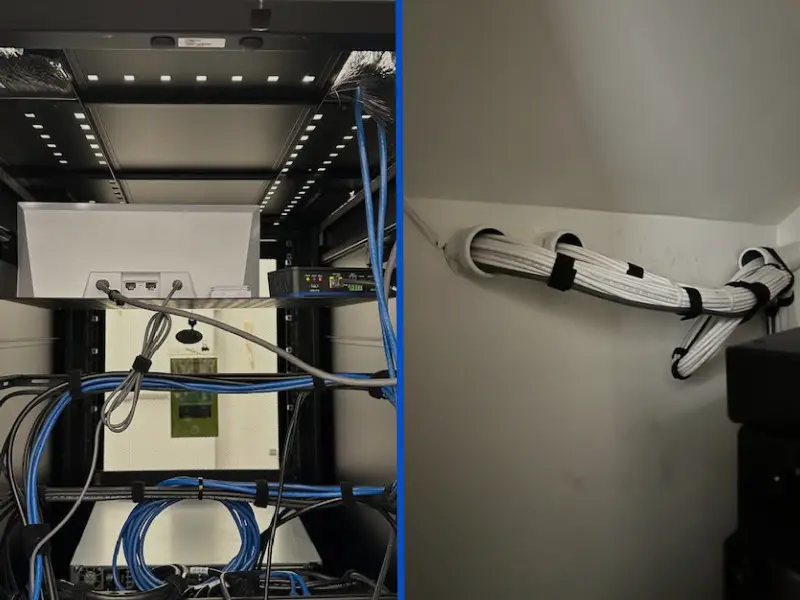
Ignoring installation quality. A satellite system is only as reliable as how it’s mounted. We’ve been called to fix dozens of “Starlink isn’t working” complaints that turned out to be poor cable runs, bad mounting, or weak grounding. Professional installation isn’t optional for business deployments.
Skipping failover. A single connection — satellite or otherwise — will eventually fail. Business deployments should include a bonded or failover router that can route traffic between satellite, cellular, and fiber when available. The cost of the failover router is trivial compared to a single hour of downtime in most operations.
Hardware and Install Differences
The two services require different hardware approaches:
Starlink Business uses proven flat or dome antennas. Mounting is well-understood — we have standard kits and procedures for rooftop, wall, pole, and tower installs. Cable runs use shielded Ethernet, and most installs finish in a single day.
Amazon Leo commercial uses new enterprise terminals. Mounting hardware, cable specs, and install procedures are still being finalized as the beta progresses. Early Amazon Leo deployments require closer coordination with Amazon’s enterprise support team during install.
In both cases, the installer matters. We’ve seen residential-grade installs fail repeatedly on commercial buildings — wrong mast height, no grounding, bad weatherproofing, no surge protection. A real commercial install includes site survey, proper RF planning, grounded and surge-protected runs, and load testing before sign-off.
Frequently Asked Questions
What is Starlink Business? Starlink Business is SpaceX’s commercial satellite internet service, offering tiered service plans designed for offices, warehouses, retail, and remote operations with higher priority and better SLAs than residential Starlink.
How much do Starlink business plans cost? Pricing varies by tier and data allowance. The standard Business tier is targeted at small-to-mid businesses; the Priority tier is for mission-critical operations with guaranteed network resources.
What is Amazon Leo internet? Amazon Leo internet is Amazon’s low-Earth-orbit (LEO) satellite broadband network, formerly known as Project Kuiper. It entered enterprise beta in April 2026, with consumer rollout targeted later in the year.
When did Amazon Leo launch? The Amazon Leo launch happened in stages — the network was rebranded from Project Kuiper in November 2025, enterprise beta opened April 8, 2026, and consumer service is expected later in 2026.
Is Amazon Leo better than Starlink Business? Not yet — Amazon Leo is in enterprise beta as of April 2026. Starlink Business is the proven production option today. Amazon Leo may become competitive once its full rollout completes, especially for AWS-integrated businesses.
Can I use both Starlink and Amazon Leo together? Yes — and for serious deployments, that’s becoming the recommended approach. Pairing the two through a bonded or failover router gives you true network diversity from independent LEO satellite internet networks.
Does Starlink Business work for fleets and mobile operations? Yes — through Starlink Mobility and Starlink Maritime tiers. These are separate services from fixed-site Starlink Business and require different hardware.
Who installs Starlink Business? AFTECHS installs Starlink Business across all 50 states, including site surveys, mounting, cable runs, network integration, and failover configuration. All work is backed by our 1-year workmanship guarantee.
There’s no universally right answer between Starlink Business and Amazon Leo. The right call depends on your timing, your location, your existing IT stack, and your uptime requirements.
AFTECHS installs both services nationwide and helps enterprise clients pick the right one — sometimes one, sometimes both, sometimes neither if a different solution fits better. Every engagement starts with a free site evaluation so you know exactly what each option will deliver at your specific location.
If you’re evaluating commercial satellite internet for 2026, request a free consultation and we’ll walk you through the decision with real numbers for your site — not generic marketing claims.