A few years ago, getting reliable internet on an RV, a boat, or a fleet vehicle meant accepting painful tradeoffs. Cellular hotspots dropped out the moment you left a city. Marine satellite systems cost a fortune and delivered speeds that made even basic browsing painful.
In 2026, that’s no longer the case.
Starlink for RV use has gone mainstream, Starlink for boats has finally made high-speed internet usable on the water, and fleet operators are standardizing on low Earth orbit satellite gear. The challenge today isn’t whether you can get fast internet on a vehicle or vessel — it’s choosing the right combination of hardware for how you actually use it.
Here’s what works in 2026, based on what we install every day for RV owners, boaters, and fleet operators.
The Three Main Options
Every mobile or marine internet setup is built from one or more of these:
- Low Earth orbit (LEO) satellite — Starlink, and increasingly Amazon Leo
- Cellular networks — 4G and 5G connections through carrier networks
- Cellular bonding and failover routers — devices that combine multiple connections into one reliable link
Well-designed setups use at least two of these together. Relying on a single connection is the most common mistake we see.
Starlink for RV: The Default Setup in 2026
For the majority of RVs in 2026, Starlink for RV use is the foundation of the internet setup. Search interest has been climbing for two years, and the related search terms — Starlink Standard kit, Starlink Mini kit, Starlink Mini mounts — tell you exactly what RV owners are actually researching when they shop.
There are three Starlink hardware tiers RV owners typically consider:
- Starlink Mini Kit — the small, low-power option built for travel; pairs well with portable or roof-mount setups
- Starlink Standard Kit — full-size dish; better throughput, larger footprint, more power draw
- Starlink Residential (adapted) — sometimes used on stationary RVs at a fixed site
Picking between them depends on three things: how often the RV moves, whether you boondock off-grid, and how much power your electrical system can spare. For full-time travelers, the Mini is usually the right call. For stationary RVs at a long-term site, the Standard kit often delivers better speeds.
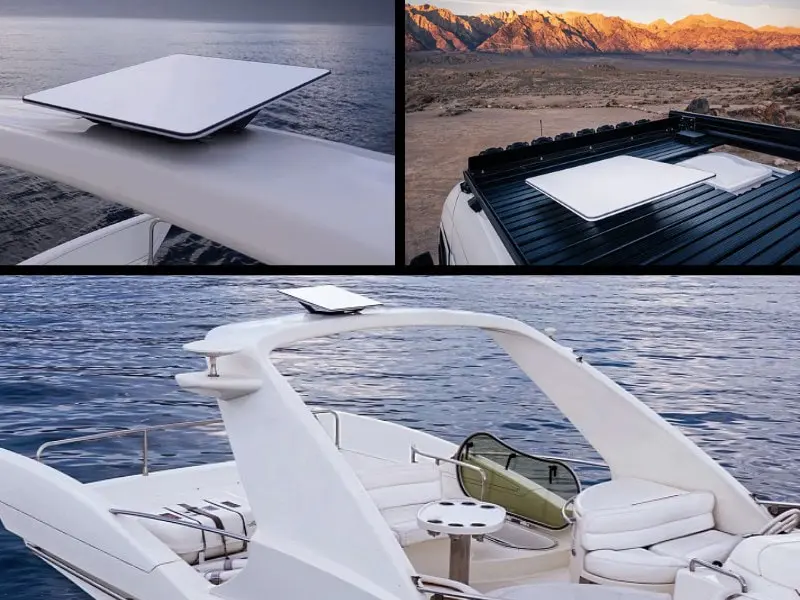
We’ve installed Starlink Mini mounts on hundreds of RVs and the most common mistake is improvising a mount that doesn’t survive highway wind speeds. Proper installation includes a rated roof mount, sealed cable entry, and a 12V-compatible power solution.
Starlink for Boats: Different Hardware, Different Rules
Starlink for boats has its own requirements that RV setups don’t share:
- Saltwater corrosion damages standard equipment quickly
- Antennas must handle motion, vibration, and weather
- Below-deck routing requires careful cable planning
- Maritime-licensed Starlink hardware is required for offshore use
- Crew, guests, and operational systems often need separate networks
A residential Starlink kit zip-tied to a railing is not a marine installation. Proper marine setups use marine-rated mounts, sealed cabling, weatherproof routers, and segmented networks that keep guests, crew, and ship systems separated.
For boats operating in open water, Starlink Maritime (or the Priority service tier) is the right license — running residential gear offshore violates the terms of service and risks deactivation at the worst possible time.
Amazon Leo: The Emerging Second Option
Amazon Leo entered enterprise beta in April 2026, with consumer rollout targeted later in the year. For mobile and marine applications it’s still early, but the long-term picture matters.
Amazon’s network is expected to include hardware aimed specifically at mobile and maritime use, with tight integration into Amazon Web Services. For fleet operators already running cloud-based logistics, that integration could matter more than raw speed.
For now, Starlink remains the practical choice. Within the next 12 to 18 months, Amazon Leo is likely to become a real second option — especially as a network-diverse backup.
Cellular: Still Essential, Even With Satellite
A common misconception is that satellite internet replaces cellular. It doesn’t — it complements it.
Cellular is still the better choice in or near a city, when you need lower power draw, and when you want a backup that doesn’t rely on a clear view of the sky. Modern 5G routers with external antennas can rival satellite in good coverage areas.
The best mobile setups use cellular as the primary connection in covered areas and switch to satellite automatically when cellular drops out.
Bonding and Failover: The Detail That Separates Good Setups From Frustrating Ones
The single biggest upgrade most RVs, boats, and fleet vehicles can make is adding a bonding or failover router.
A bonding router combines multiple connections — satellite, cellular, marina Wi-Fi — into a single, more reliable link. If one connection slows or drops, the router shifts traffic to the others without dropping calls or interrupting streams.
For a business operating a fleet, this isn’t a luxury. It’s the difference between drivers staying productive and constant complaints about dropped calls and frozen apps.
Satellite Internet for Fleet Vehicles: Scale Changes Everything
Fleet installations focus on consistency:
- Identical hardware across every vehicle so drivers and IT teams aren’t guessing
- Centralized management so connections, data usage, and uptime can be monitored
- Fast deployment so vehicles don’t sit idle waiting for installs
- Reliable failover so a single dropped connection doesn’t shut down operations
One of our recent fleet rollouts involved more than 75 service vehicles across eight states, all equipped with Starlink Mini systems and standardized routing. That kind of consistency is only possible when the entire deployment is planned and installed by the same team.
Frequently Asked Questions
Does Starlink for RV work while driving? The Starlink Mini supports in-motion use on appropriate service plans. Standard kits are designed primarily for stationary use.
What’s the difference between the Starlink Mini and Standard kits for RVs? The Mini is smaller, lower power draw, and better for travel. The Standard kit delivers higher throughput and is better for stationary RVs at long-term sites.
How much does Starlink for RV cost per month? Service-plan pricing varies by tier — full-time travelers typically use Roam Unlimited, while occasional users choose lower-cost tiers that pause when not in use.
Is Starlink for boats legal to use offshore? Yes — with the correct maritime service plan and licensed hardware. Residential plans are not authorized for open-water use.
Can a fleet use one Starlink account across many vehicles? Fleet-tier Starlink Business accounts support multi-vehicle deployment with centralized billing and management.
Will Starlink for campers work in remote campsites? Yes — that’s exactly what it’s designed for. As long as you have a clear view of the sky, Starlink works in places cellular usually doesn’t.
There’s no single best mobile or marine internet system — only the right one for how you actually use the vehicle or vessel. A weekend RV traveler doesn’t need what a full-time digital nomad needs, and neither one needs what a 60-foot yacht or a national service fleet needs.
AFTECHS installs marine and mobile connectivity systems nationwide — from single-vessel boat installs to multi-state fleet rollouts. Every project starts with a free consultation to match equipment to your actual usage, not just what’s popular this month.
If you’re tired of dropped connections, slow speeds, or systems that don’t work where you actually go, contact us and we’ll help you build a setup that performs everywhere you need it to.